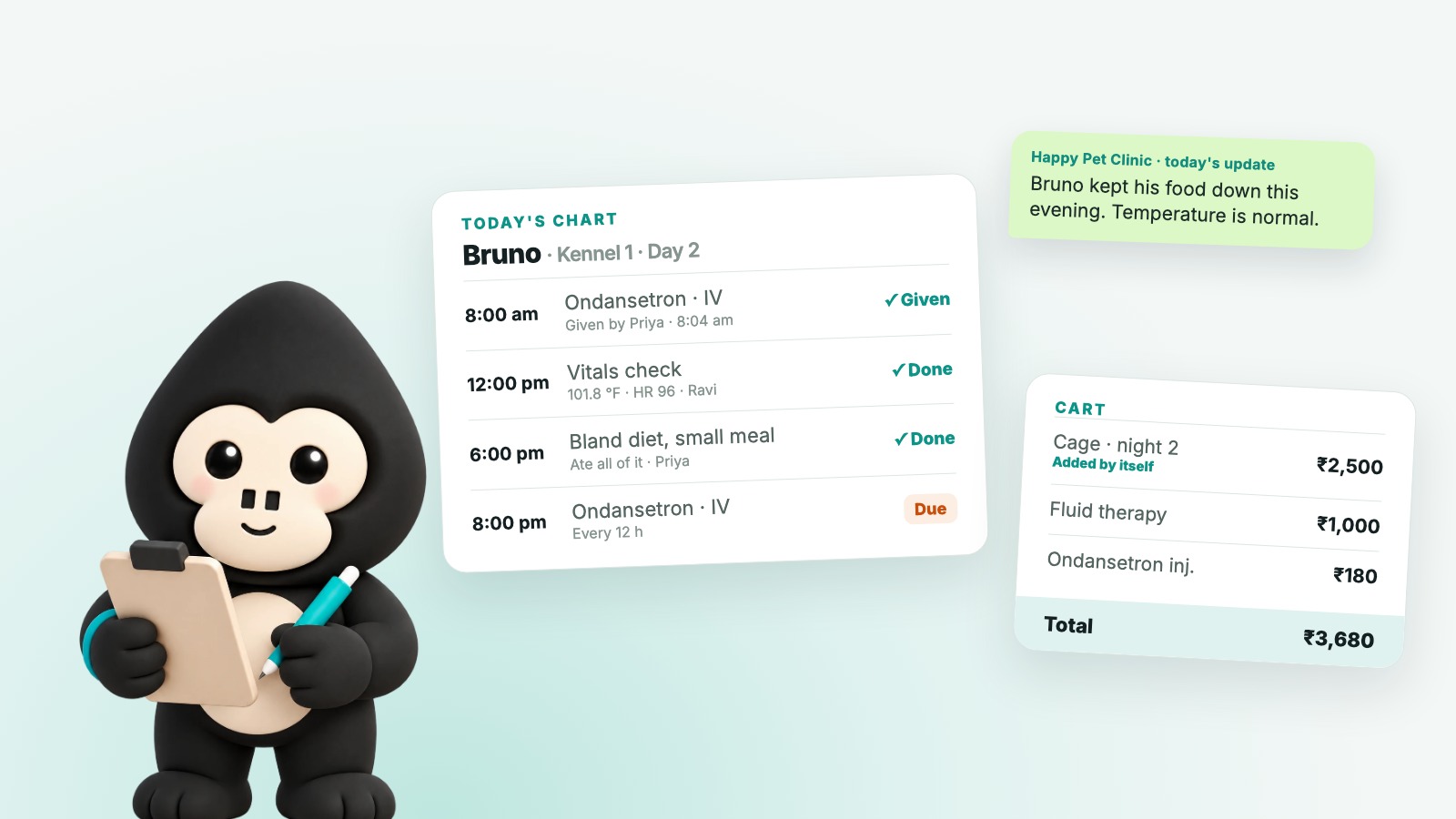
Walk into the in-patient area of most vet clinics and you'll find the same thing on every kennel: a sheet of paper on a clipboard. Temperature at 6, fluids started at 8, ondansetron given at... someone's initials, a time, maybe. It works on a quiet day with one doctor and one patient. It starts to break when the ward fills up, the night shift takes over and the pet parent calls for the fourth time.
This guide is for clinics and hospitals that admit pets: what the paper sheet quietly costs you, what a good in-patient setup needs, and a simple way to run a stay from admission to discharge.
Where the paper treatment sheet lets you down
Nobody chooses paper because it's good. It's just what was there when the clinic started admitting pets. And it fails in the same three places at almost every clinic.
1. Doses get missed at shift change
The day team writes "inj. given" with a tick. The night team can't tell whether that was the 8 am dose or the 2 pm dose, or who gave it. So one of two things happens: a dose is skipped because everyone assumed it was done, or it's given twice to be safe. Neither is good medicine, and neither shows up anywhere until something goes wrong.
2. Nights and treatments go unbilled
Every in-patient day carries charges: the cage, the IV fluids, the injections, the tests run at midnight. On paper, they live on the treatment sheet, and the bill is written from memory at discharge. Something always falls through. A night that was never charged. Fluids counted as one bag instead of three. Across a month of admissions, it adds up to real money the clinic earned and never collected.
3. The phone doesn't stop ringing
A pet parent with a dog on a drip is worried, and worry means calls. "How is he doing? Has he eaten? When can I visit?" Each call pulls a doctor or nurse away from the ward to walk to the kennel, read the sheet and ring back. Multiply that by every admitted pet and every anxious family member.
None of this is the team's fault. Paper simply wasn't built to share information between shifts, the billing desk and the family at home.
What a good in-patient setup needs
Whether you use software or not, a stay that runs well has four things:
- A list of what's due, by time. Every medicine, feed and check for today, so nobody has to work it out from the doctor's notes.
- A log with who and when. Every dose, vital sign and observation records the person and the time, so the next shift knows exactly what happened.
- Billing as you go. Charges are added when the care is given, not reconstructed at discharge.
- Updates the family can count on. One clear message a day beats five anxious calls.
A day in a stay: Bruno on IV fluids
Here's how a stay runs when all four are in place. Bruno, a two-year-old Labrador, comes in vomiting and dehydrated. The doctor decides to admit him for three days.
Admission. The front desk picks Bruno, a kennel and the doctor in charge, and writes the reason. Bruno now appears on the in-patient list with his unit, day of stay, doctor, last vitals and anything due.
The doctor's round. The doctor examines Bruno and writes the round the way they write any visit: vitals, notes, prescription. For a stay, each medicine also gets a route and times. Ondansetron, IV, every 12 hours, for three days.
The chart. Those times land on today's chart on their own, next to the monitoring the doctor asked for: temperature, heart rate and hydration four times a day, with a note to call the doctor above 104 °F. The nurse doesn't need to read the doctor's handwriting. The chart says what's due and when.
Giving the dose. At 8 pm the nurse gives the injection and marks it: given, missed, refused or held. The chart shows who did it and when, and the night shift sees it the moment they start.
Billing. The night's cage charge goes onto Bruno's bill by itself. The injection and the fluids are added as they're given. The clinic can bill once a day or whenever it likes, and the family sees what's billed, paid and due at any point. If they paid an advance, it's used against the stay's bills.
The evening update. Instead of waiting for the call, the clinic sends one message: Bruno's latest checks, today's bills and a line from the doctor. "Bruno kept his food down this evening. We'll start a bland diet tomorrow."
Discharge. On day three, the doctor opens the discharge. The stay summary is already written from the stay itself: reason, treatment, rounds, vitals. The doctor adds his condition, care at home, take-home medicines and a follow-up date. The family gets the summary, and the follow-up reminder goes out like any other.
Nothing in that day is clever. It's simply what happens when the record, the chart, the bill and the update all come from the same place.
Before you start: a short checklist
- List your units. Kennels, cages, ICU, isolation. Give each a name the team already uses.
- Set a per-day charge for each. If an ICU night costs more than a kennel night, the units should say so.
- Decide who admits and who discharges. Usually the desk admits and a doctor discharges. Agree on who can close a stay with money still due.
- Agree an update time. One message to every family at the same time each evening sets expectations and cuts the calls.
- Ask for an advance on longer stays. It's easier to agree at admission than to collect at discharge.
How Koko helps
Koko's In-patients puts everything about a stay on one page, inside the same software your clinic already uses for visits and billing.
- Every dose on time. Medicines from doctor rounds go onto the Chart with their times, and a time turns Due an hour before. Your team marks each one done, and the Chart shows who did it and when.
- Every night billed. Each unit has its per-day charge, and every night a pet stays goes into the stay's Cart by itself. Add injections, fluids, tests and products, and check out whenever you like.
- Families kept in the loop. Send the day's update on WhatsApp in one tap, with the latest checks, today's bills and a line in your own words.
- The ward at a glance. The In-patients list shows every pet staying now, with doses overdue and amounts due at the top.
- Discharge written for you. Koko drafts the stay summary from the stay. The doctor adds the outcome and care at home, and it goes to the family on WhatsApp.
- The whole stay on the pet's profile. The log, the bills and the summary stay in the pet's medical history for the next visit.
Want to see it with your own wards? Book a free demo.
Frequently asked questions
Do we need separate software for in-patients?
No. In Koko, a stay uses the same pets, prescriptions, products and billing as your visits. Doctor rounds are written on the usual visit page.
Can we bill every day instead of at discharge?
Yes. Bill once a day, twice a day or only at the end. Each bill shows under the stay's Invoices.
Can we take an advance at admission?
Yes. Add it to the pet parent's wallet, and it pays the stay's bills at checkout. The pet parent gets a receipt on WhatsApp.
What if a pet is discharged with money still due?
Only an admin can complete a discharge while items are still in the Cart or money is due, so it doesn't happen by accident.
How do we switch it on?
In-patients is switched on for each branch by the Koko team. If you're already on Koko, message us and we'll set it up with your units.
Ready to Modernize Your Clinic?
Discover how Koko can streamline your operations and enhance pet care.
Schedule a Free Demo